How To Fix a Broken Sauce Before It Ruins Your Dinner
If you feel like you did everything right. You followed the recipe. And then your sauce just… fell apart. The butter floated to the top in sad little puddles. The hollandaise turned grainy and thin. The whole thing looks like a science experiment gone wrong instead of dinner.
Here’s the thing nobody tells you… This happens to experienced cooks and Chefs, too. Me included.
I am currently reformatting a dining operation to a French concept.
I’ve made Beurre Blanc a million times.
And… my first go around, in front of all the cooks, a broken mess. I recovered quickly. But it still happens.
A broken sauce isn’t a sign you failed – it’s a sign the emulsion lost its grip.
Greasy, separated sauces are fixable.
Most of the time, completely fixable. But the advice you find online is either too vague (“just whisk it more!”) or buried under ten paragraphs of food history before you get to anything useful.
We’re going to change that. This guide gives you the actual fixes – organized by how broken your sauce is and what kind of sauce you’re dealing with. No filler.
What Is a Broken Sauce?

A broken sauce is an emulsion that collapsed.
Emulsions are what happen when fat and water are forced to coexist – think hollandaise, mayonnaise, beurre blanc, cream sauces, pan sauces. They stay together because of emulsifiers like egg yolk lecithin, which coats tiny fat globules and keeps them suspended in the liquid.
When the emulsion fails, those fat globules clump back together and float to the surface as oil or butter, leaving a thin, watery mess underneath.
What you’re looking at when a sauce breaks: an oily sheen on top, a watery or grainy texture underneath, and a sauce that no longer coats anything the way it should.
Who This Guide Is For
This is for anyone who has:
- Pulled a hollandaise off heat and watched it separate
- Made an alfredo that turned greasy and curdled mid-stir
- Finished a pan sauce only to see the butter pool up on top
- Attempted beurre blanc and ended up with warm lemony butter water
Doesn’t matter if you’ve been cooking for two years or twenty. Sauces break on everyone.
Why This Method Works
The reason most attempts to fix a broken sauce fail is simple: people add the wrong thing. Butter to a sauce that already has too much fat. Flour or cornstarch to a butter sauce (this doesn’t work – thickeners can’t rebuild an emulsion). More cream when the problem is overheated dairy proteins.
The right fix depends on what broke and how badly.
When a sauce breaks from too much heat, the proteins in dairy or egg have denatured – they’ve cooked past the point where they can hold the emulsion together.
When a sauce breaks because fat was added too fast, the fat globules never got dispersed evenly in the first place. When it broke because it sat too long and cooled unevenly, the emulsion just lost the energy it needed to stay stable.
Each cause has a different fix.
Temperature shock – adding cold butter to a scorching pan – is one of the fastest ways to break a sauce, and also one of the most common mistakes.
Whisking speed matters too: too slow and the fat pools; too fast and you introduce air without creating emulsion.
The fixes below work because they either re-emulsify around a new emulsifier (egg yolk), reintroduce enough liquid to rebalance the fat ratio, or use vigorous heat and motion to force the fat back into suspension.
Understanding the science of a broken sauce starts with your ingredients. For example, when making a pan sauce, the ratio of fat to liquid is critical; this is why we emphasize the importance of kitchen scales
for precision, especially when you are doubling a recipe and the margin for error shrinks.
Tools You’ll Need
Nothing special. What you probably already have:
- A whisk (the most important one)
- A small clean bowl or saucepan
- An immersion blender (optional but useful for the nuclear option)
- A fine-mesh strainer if your sauce has curdled solids
One egg yolk is often all you need to rebuild a fully broken sauce. Heavy cream helps with dairy-based ones. Warm water – just warm, not boiling – is the secret weapon for pan sauces and butter sauces.
While a standard whisk is your best friend here, having a grasp on the names of cooking equipment in your arsenal—like a heavy-bottomed saucier—can prevent the hot spots that cause dairy to break in the first place.
Quick Guide: How To Fix a Broken Sauce
Here’s the short version for the visual learners:
- Pull it off the heat immediately. Stop the damage before you fix it.
- Figure out how broken it is. Fat droplets at the edges = early stage. Fully separated pools of oil = fully broken.
- Early stage: Add 1–2 tsp of base liquid (water, stock, or cream) and whisk hard.
- Fully broken egg-based sauce: Whisk a fresh egg yolk + 1 tbsp liquid in a clean bowl, then slowly whisk the broken sauce in, one teaspoon at a time.
- Fully broken butter or pan sauce: Add ¼ cup warm water and bring to a vigorous simmer, whisking constantly.
- Fully broken cream sauce: Reduce ½ cup fresh heavy cream by one-third, then slowly whisk in the broken sauce.
The detailed instructions are below if you want to see exactly how we do it.
Comprehensive Sauce Rescue Guide
Emergency fix ratios — broken sauce cheat sheet
Hollandaise
Egg-basedFix liquid
1 tbsp warm water — add into the fresh yolk base first, not straight into the broken sauce
Secret weapon
1 fresh egg yolk in a clean bowl. Whisk broken sauce back in one teaspoon at a time. The lecithin in the new yolk rebuilds the emulsion from scratch.
Béarnaise
Egg-basedFix liquid
1 tbsp warm water — move fast, off the double boiler immediately
Secret weapon
1 fresh egg yolk + 1 tsp tarragon reduction — same rebuild method as hollandaise. Speed matters here before eggs overcook.
Mayonnaise also aioli
Egg-basedFix liquid
1 tsp cold water or lemon juice — cold is better here, not warm
Secret weapon
1 fresh egg yolk in a clean bowl. Drizzle the broken emulsion back in drop by drop — slower than you think you need to go.
Beurre blanc
Butter-basedFix liquid
1 tbsp warm water — pull off heat first, then add the water
Secret weapon
1 small cube of cold butter — cold butter is already emulsified. It re-seeds the broken sauce. Whisk vigorously off heat.
Pan sauce
Butter-basedFix liquid
¼ cup warm water — right into the hot pan while still on medium heat
Secret weapon
Vigorous simmer + constant whisking — the bubbling action forces butter back into suspension. No extra ingredients needed.
Alfredo cream pasta sauce
Cream-basedFix liquid
2 tbsp warm cream — never add cold cream to a hot pan
Secret weapon
Reduce ½ cup heavy cream to ⅓ volume first — then slowly whisk the broken sauce into the concentrated cream base. The reduction is thick enough to absorb it.
Carbonara
Cream-basedFix liquid
2 tbsp pasta cooking water — must be starchy, not plain water
Secret weapon
Remove from heat entirely — toss vigorously off the burner. Residual pan heat is enough. The starch in pasta water helps bind the egg back together.
Cheese sauce mornay, queso, mac
Cream-basedFix liquid
2 tbsp warm whole milk — off heat before adding
Secret weapon
Off heat + immersion blender — always grate cheese fresh. Pre-shredded has anti-caking agents that actively prevent smooth melting.
Vinaigrette
Oil-basedFix liquid
1 tsp wine vinegar — start in a clean bowl, not back into the broken dressing
Secret weapon
1 tsp Dijon mustard as new base — mustard has its own natural emulsifiers. Slowly whisk the broken dressing back in. Done in two minutes.
Caesar dressing
Oil-basedFix liquid
1 tsp lemon juice or cold water — into a clean bowl first
Secret weapon
1 fresh egg yolk + 1 tsp Dijon — the double emulsifier base. Drizzle the broken dressing back in very slowly.
Gravy
Stock-basedFix liquid
¼ cup warm stock — same type as the gravy base, always warm not cold
Secret weapon
Steady whisk over medium heat + strain if lumpy — a fine-mesh sieve removes any curdled solids. Cold stock into a hot roux is the most common cause.
Tomato sauce
Stock-basedFix liquid
2 tbsp pasta cooking water — starchy water, not plain tap water
Secret weapon
1 tbsp tomato paste + immersion blender — paste adds pectin and body; the blender quickly re-incorporates the separated oil.
Step-By-Step Instructions To Fix Broken Sauce
Step 1 – Take It Off the Heat
The very first thing. Every time.
Overheating is the number one reason sauces break. The longer a broken sauce stays on heat, the harder it is to fix – especially with egg-based sauces like hollandaise or béarnaise, where continued cooking scrambles the egg proteins completely. Once that happens, there’s no coming back.
Remove the pan from the burner. Set it aside for 60 seconds before doing anything else. Let things calm down a little.
Step 2 – Diagnose the Damage

Look at your sauce. Specifically:
Early stage breaking: You’ll see small fat droplets or a greasy ring forming around the edges. The sauce still looks mostly intact but is losing cohesion. This is the easy fix.
Fully broken: The sauce has clearly separated into two distinct components – an oily or buttery layer floating on top, a thin watery or grainy layer below. It looks like two different sauces coexisting badly.
Knowing which stage you’re in tells you exactly what to do next.
Step 3 – Early Stage Fix (Works for Almost Any Sauce)
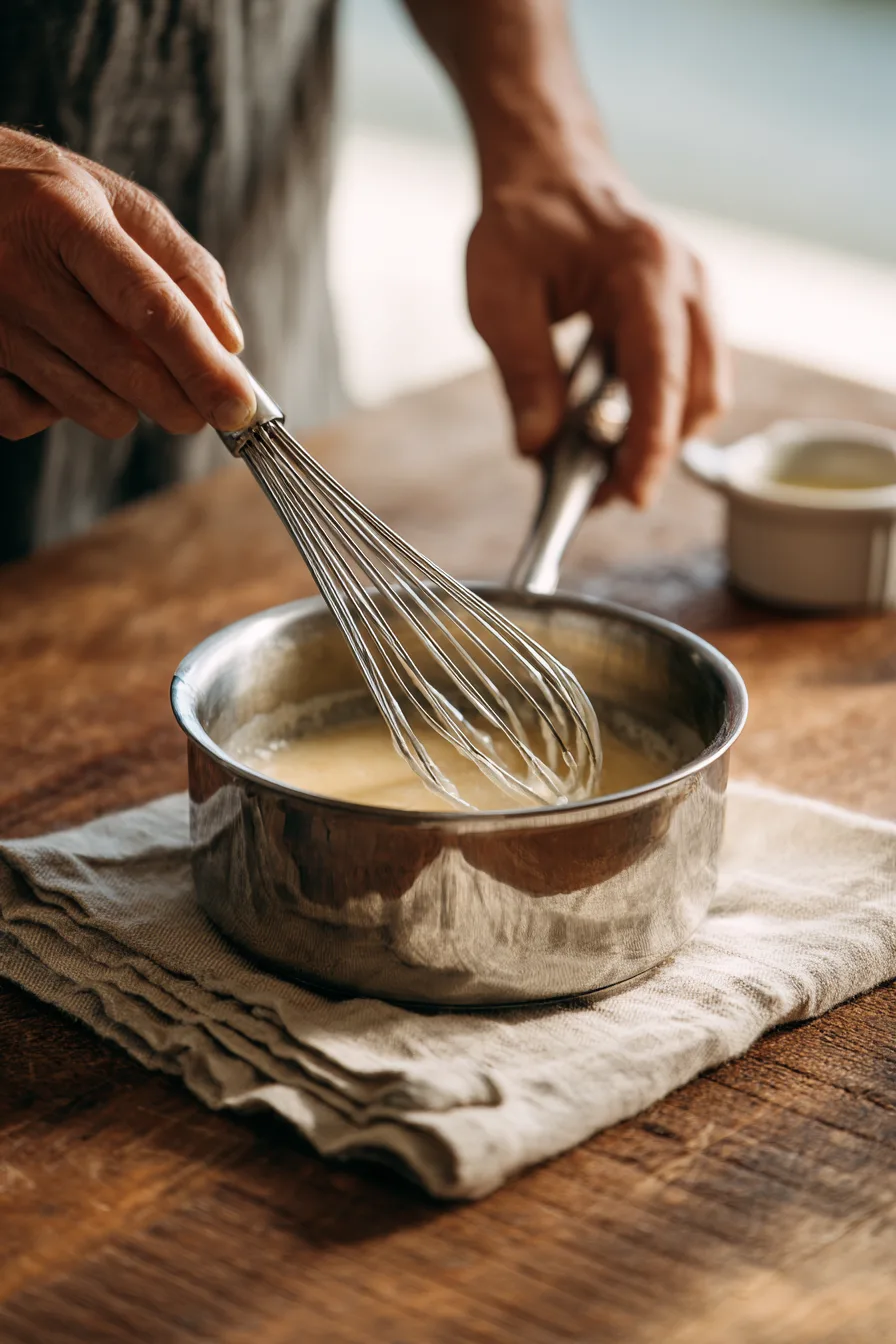
If the sauce is just starting to break, here’s what to do:
Stop adding fat. Don’t add more butter, more oil, more cream – whatever you’re adding, pause.
Add a teaspoon or two of your base liquid instead.
For butter or pan sauces, that’s warm water or stock.
For cream sauces, it’s warm cream.
For vinaigrettes or aioli, it’s a few drops of vinegar or water.
Whisk hard. Quickly. Whisking speed is doing work here – it forces the fat globules back into contact with the liquid and gives lecithin or other emulsifiers the chance to coat them again. You should feel the sauce tighten up within 10–15 seconds.
Once it pulls back together, pick up where you left off – but slower with the fat additions.
Step 4 – Fully Broken Egg-Based Sauce (Hollandaise, Béarnaise, Mayonnaise, Aioli)
This one needs a fresh start on the emulsion. Don’t skip steps.
Grab a clean bowl. Whisk together one egg yolk and one tablespoon of your base liquid (water for hollandaise, lemon juice for mayo). That yolk is your new emulsifying base – the lecithin in it is what holds everything together.
Now: add the broken sauce into the yolk. One teaspoon at a time. Whisk constantly between each addition. You’re asking the yolk to absorb and emulsify each small amount before you add more. After three or four additions you’ll feel the mixture start to thicken and go glossy – that’s the emulsion forming. Once it’s holding, you can pick up the pace slightly.
If you’re working with a warm sauce over a double boiler, make sure the bowl isn’t scorching when you start. Temperature shock can cook the fresh yolk before it gets a chance to do its job.
The egg yolk method is the gold standard for saving some of the 5 French mother sauces
that rely on emulsification. Because these sauces are so temperamental, mastering basic cooking terms explained in our glossary will help you spot the difference between ‘simmering’ and ‘scrambling’ before it’s too late.
Step 5 – Fully Broken Butter Sauce or Pan Sauce
This is America’s Test Kitchen’s method and it works.
Add about ¼ cup of warm water to the pan. Bring it to a vigorous simmer over medium heat, whisking the whole time. The combination of heat and constant whisking forces the butter back into suspension. The bubbling helps too – it creates tiny droplets of fat that can redistribute.
Don’t use cornstarch. Don’t use flour. Those thicken the liquid but can’t rebuild the emulsion – you’ll end up with a thick greasy sauce instead of a thin greasy sauce, which isn’t actually progress.
Keep whisking as the sauce reduces back to your target consistency.
Step 6 – Fully Broken Cream Sauce (Alfredo, Carbonara, Vodka Sauce)
Grab a small saucepan and add ½ cup of fresh heavy cream. Reduce it over medium heat until it drops to about ⅓ of its volume – it should look thick and coat the back of a spoon.
Now slowly pour and whisk the broken sauce into the reduced cream. A steady thin stream while whisking. The concentrated cream is rich enough in fat and dairy proteins to absorb and re-emulsify the broken sauce around it.
This is the same principle as the egg yolk method – you’re giving the broken sauce a stable new base to latch onto.
Step 7 – The Blender Fallback
If whisking by hand isn’t working, an immersion blender often will.
Pour the broken sauce into a tall container. Add one tablespoon of very hot (not boiling) water. Blend. The mechanical action of the blender is far more aggressive than hand-whisking and can force an emulsion even when the fat-to-liquid ratio is off.
This works particularly well for cold-broken sauces – hollandaise that sat too long, aioli that came out of the fridge, any sauce that broke because it lost heat and stability rather than overheating.
Common Mistakes
Adding more fat to fix it. Almost always makes it worse. If the sauce broke because the emulsion was overwhelmed, adding more of the thing that overwhelmed it isn’t the answer.
Using cold butter in a hot pan. Temperature shock destabilizes emulsions fast. If a recipe tells you to mount a sauce with butter at the end, use cool – not cold – butter cut into small pieces, and add it slowly.
Trying to fix a fully broken sauce with the early-stage method. If it’s fully separated, a teaspoon of liquid and some whisking won’t be enough. You need the egg yolk rebuild or the reduced cream method.
Letting it keep cooking while you figure out what to do. Every second on heat is making the problem harder to solve.
Pre-shredded cheese in a cheese sauce. Pre-shredded cheese has anti-caking agents that prevent smooth melting. Always grate from a block.
For the smoothest possible mac and cheese or queso, we recommend using molecular gastronomy shortcuts, such as how to use sodium citrate to make cheese sauce, which acts as a powerful stabilizer that prevents the proteins from clumping.
Pro Tips
- When making hollandaise from scratch, keep heat at a whisper. If the bowl gets too hot to touch the bottom, pull it off the double boiler for a moment.
- For beurre blanc, make sure the wine and vinegar are fully reduced before you start adding butter. Unreduced acid fights the emulsion the whole way.
- If you have to start a fresh base, don’t throw the broken sauce out. Build the new base stable, then slowly add the broken sauce into it. You end up with more sauce. Not a tragedy.
- A splash of mustard into vinaigrettes adds stability. Mustard contains its own natural emulsifiers and acts as backup insurance.
One of the biggest culprits of a broken sauce isn’t your technique – it’s your measurements. If you accidentally add too much oil or butter because you didn’t measure liquids
or measure butter and fats accurately, the emulsion simply won’t have enough water to hold onto.
Variations by Sauce Type
Cheese sauce (queso, mornay, mac and cheese): Remove from heat. Whisk in a splash of warm whole milk or cream. If it’s already grainy, try an immersion blender or strain out the curdled solids. A small roux (equal parts butter and flour, cooked together first) added to a new batch can add stability for next time.
Tomato-based sauce: Tomato sauces don’t have the same emulsion structure as butter sauces, but they do break when overreduced or when oil separates from the tomatoes. Stir in a spoonful of tomato paste and whisk or use an immersion blender. A splash of pasta cooking water works well here too – the starch helps hold things together.
Gravy: Same as the pan sauce method – add warm stock or water and whisk over medium heat. If it’s lumpy rather than greasy, strain it.
Vinaigrette: Broken vinaigrettes are easy. Start fresh with just a teaspoon of mustard and a splash of vinegar in a clean bowl, then slowly whisk the broken dressing back in. Done in under two minutes.
Storage
Most emulsified sauces – hollandaise, béarnaise, beurre blanc – are best made fresh and served right away. They don’t hold well.
Leftover cream sauce or pan sauce keeps in the fridge for up to three days. Reheat gently over low heat while whisking. Don’t boil it. If it breaks on reheating, use the early-stage fix: a splash of warm liquid and vigorous whisking. Cold-broken sauces like aioli or mayo often respond well to the blender method.
Questions I get About Broken Sauce
Usually heat or speed. Hollandaise needs a low double boiler – eggs scramble fast. Add the butter slowly, especially at the start. If it keeps breaking, try making it in a blender from scratch; the mechanical emulsification is more forgiving.
Yes. Egg yolk is ideal for egg-based sauces, but for butter and pan sauces use warm water; for cream sauces use reduced heavy cream. An immersion blender works as a fallback for most types.
If the egg proteins have cooked into scrambled eggs, no amount of whisking brings it back. Start a fresh base and slowly add the broken sauce into the new egg yolk – use it as the fat source.
Yes. Too slow and fat pools; too fast and you’re just adding air. You want a quick, steady circular motion – fast enough to keep things moving, not so fast you’re splashing.
Heat too high, or cold cream hitting a hot pan. Warm the cream before adding it. Never boil an alfredo – low heat and constant gentle stirring once the cheese goes in.
Yes, just unpleasant in texture. The only real concern is undercooked egg in hollandaise – make sure it reaches at least 145°F.
Often yes. The blender method works well for cold-broken sauces. For cream sauces, reheat gently while whisking and add a splash of warm cream if needed.
The Final Bite
A broken sauce isn’t failure – it’s just chemistry asking you to slow down.
Every fix in this guide is something I’ve used on an actual line, usually under pressure, usually with someone waiting.
The egg yolk rebuild, the cold butter trick, the vigorous simmer with water — these aren’t hacks. They’re how professional kitchens keep moving.
Once you understand why a sauce breaks, you stop fearing it. And honestly, that’s the real skill.
If this kind of practical, no-filler cooking knowledge is useful to you, I put more of it in the Simply Delicious Digest – a newsletter from Savore Media with recipes, technique, and kitchen logic worth keeping. Worth a look.
– Ryan Yates, Executive Chef
Disclosure: Every guide here is written and tested by Ryan Yates, a Le Cordon Bleu-trained chef with more than 20 years in professional kitchens. Editorial tools help with formatting and structure. This post may contain affiliate links — if you buy through one we may earn a small commission, at no extra cost to you.