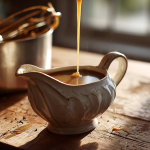
Description
A gravy built on roasted turkey wings and thickened with the fat skimmed off its own stock, so it survives freezing and reheats without separating. Season it to about eighty percent and finish with roasting-pan drippings on the day. Makes six cups.
Equipment Needed
Rimmed sheet pan, 8-quart stockpot, fine-mesh strainer, heavy-bottomed 4-quart saucepan, flat whisk, fat separator (optional but useful on serving day)
Ingredients
For the stock
- 3 lb turkey wings (about 3 wings), split at the joints
- 1 tbsp neutral oil
- 1 large yellow onion, quartered
- 2 medium carrots, cut in thirds
- 2 celery ribs, cut in thirds
- 8 sprigs fresh thyme
- 2 bay leaves
- 1 tsp black peppercorns
- 11 cups cold water, divided
For the gravy
- 10 tbsp reserved turkey fat, skimmed from the chilled stock
- 10 tbsp all-purpose flour
- 6 cups strained turkey stock, warm
- 1 tbsp soy sauce or tamari
- 2 tsp sherry vinegar
- Kosher salt
- Freshly ground black pepper
For finishing on serving day
- 1/2 to 1 cup defatted roasting-pan drippings, strained
Instructions
- Heat the oven to 425°F. Toss the turkey wings with the oil on a rimmed sheet pan in a single layer. Roast 35 minutes.
- Add the onion, carrot, and celery to the pan. Roast 20 minutes more, until the wing skin is deep brown and the pan bottom is streaked with stuck-on fond.
- Transfer the wings and vegetables to a stockpot. Set the sheet pan over a burner on medium, add 1 cup water, and scrape the fond loose with a wooden spoon while it steams. Pour all of it into the pot.
- Add the remaining 10 cups water, thyme, bay leaves, and peppercorns. Bring to a bare simmer, with bubbles breaking the surface only occasionally. Skim the foam that rises in the first 15 minutes.
- Simmer uncovered 2 hours, never letting it reach a rolling boil. The stock should reduce to roughly 7 cups.
- Strain through a fine-mesh strainer into a bowl. Discard the solids. Refrigerate uncovered until cold, then cover. Overnight is best.
- Lift the set fat cap off the surface. Reserve 10 tablespoons of that fat. The stock underneath should jiggle like loose gelatin when you shake the bowl.
- Warm 6 cups of the stock in a saucepan to a simmer. Reserve the rest for thinning later.
- Melt the turkey fat in a heavy 4-quart saucepan over medium heat. Whisk in the flour and cook 4 to 5 minutes, whisking constantly, until the roux is the color of peanut butter and smells nutty.
- Add the hot stock in three additions, whisking each one fully smooth before the next. Bring to a low bubble and cook 10 minutes, whisking often, until the gravy coats a spoon and holds a line when you draw a finger through it.
- Off the heat, whisk in the soy sauce and sherry vinegar. Season with salt and pepper to about eighty percent of where you want it, so the drippings have room later.
- Pour into a shallow pan to cool fast, below 40°F within 2 hours. Portion into 2-cup containers. Refrigerate up to 4 days or freeze up to 3 months.
- To serve: thaw overnight in the refrigerator. Reheat over medium-low with a flat whisk. It will look separated for the first minute. Keep whisking. Thin with warm reserved stock as needed.
- Pour the roasting-pan drippings into a fat separator, discard the fat, and strain. Whisk into the warm gravy a half cup at a time, tasting between additions. Adjust salt last.
Notes
I build the roux with fat skimmed off the chilled stock rather than butter. Butter is roughly 80% fat and 16% water, so a cup measured against a cup of flour leaves the flour under-coated and prone to clumping, and the water has to boil off before the roux develops at all. Skimmed turkey fat is pure fat. It coats every flour particle, which is what prevents lumps, and it carries the roasted flavor of the wings into the thickener instead of layering a dairy note over it.
I ran the same stock two ways. The cornstarch-thickened batch looked correct going into the freezer and came out weeping, a ring of water around a gravy that had lost its structure. The flour batch from identical stock came back cloudy for about ninety seconds on the stove and whisked smooth. The thickener you choose is a storage decision before it is a texture one, and no recipe I found said so.