Creamy Chicken and Wild Rice Soup That Holds Its Texture
Most creamy chicken and wild rice soup goes wrong two days after you make it, not during cooking.
The rice keeps swelling in the fridge, the cream tightens up when it’s reheated, and what was silky on night one turns into something closer to porridge with chicken in it by night three.
The fix isn’t a different recipe, it’s treating the rice and the cream as two separate problems that happen to share a pot.
Why Wild Rice Needs Its Own Pot
True wild rice isn’t a grain in the botanical sense, it’s an aquatic grass seed, and it behaves differently from the white or brown rice most soup recipes assume. It takes 45 to 60 minutes to fully bloom, and even after it looks done, it keeps drinking liquid for hours.
Cook it directly in the cream base for the full simmer and you’ll get two problems at once: the rice turns soft at the edges while staying chalky at the core, and the starch it sheds thickens the broth unevenly, so what’s silky at the stove turns gluey by the time it hits the bowl.
Cook the wild rice separately, in plain salted water or broth, and stir it into the soup only in the last ten minutes.
That’s the technique decision that changes this recipe: the rice finishes properly, on its own timeline, and it stops competing with the cream for control of the texture. You get a broth that stays pourable and a rice bite that’s chewy rather than blown out.

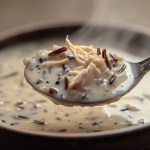
Creamy Chicken and Wild Rice Soup
- Prep Time: 15 minutes
- Cook Time: 55 minutes
- Total Time: 1 hour 10 minutes
- Yield: 6 servings 1x
- Category: Soup, Dinner, Lunch
- Method: Stovetop
- Cuisine: American – Upper Midwest
Description
A cream-based chicken soup built around wild rice cooked separately and stirred in at the end, so the texture holds up on day one and on day three. Thigh meat poached directly in the broth carries most of the flavor.
Equipment: Large Dutch oven or heavy-bottomed soup pot (5–6 quart), separate 2-quart saucepan for the rice, instant-read thermometer
Ingredients
For the rice:
1 cup wild rice, rinsed
2 1/2 cups water or chicken broth
1/2 tsp salt
For the soup base:
4 tbsp unsalted butter
1 medium yellow onion, diced
2 carrots, diced
2 celery stalks, diced
3 garlic cloves, minced
1/3 cup all-purpose flour
6 cups chicken broth
1.5 lbs boneless, skinless chicken thighs
1 bay leaf
1 tsp dried thyme
1 cup heavy cream
1 cup whole milk
Salt and black pepper, to taste
Instructions
Combine the wild rice, water or broth, and salt in a separate saucepan. Bring to a boil, reduce to a low simmer, cover, and cook 45–50 minutes, until the grains split open and show a soft interior. Drain any excess liquid and set aside.
In a large Dutch oven or soup pot, melt the butter over medium heat. Add the onion, carrots, and celery, and cook 6–7 minutes, until the onion turns translucent and the vegetables soften.
Add the garlic and cook 30 seconds, until fragrant.
Sprinkle the flour over the vegetables and stir constantly for 1–2 minutes, until it coats everything and smells lightly toasted.
Slowly pour in the chicken broth, whisking as you go to prevent lumps. Add the chicken thighs, bay leaf, and thyme.
Bring to a simmer, then reduce heat to maintain a gentle bubble. Cook 20–25 minutes, until the chicken reaches 165°F internally.
Remove the chicken to a cutting board and let it rest 5 minutes, then shred it into bite-sized pieces using two forks.
In a separate bowl, whisk the heavy cream and milk with a ladleful of the hot broth from the pot to temper it.
Remove the pot from direct heat and stir the tempered cream mixture into the soup.
Return the shredded chicken and cooked wild rice to the pot. Warm through over low heat for 5 minutes — do not let it boil.
Remove the bay leaf. Season with salt and pepper to taste before serving.
Notes
Chef Technique Decision: The wild rice is cooked in its own pot and added in the last few minutes rather than simmered in the broth from the start. Wild rice keeps absorbing liquid well past the point it looks done, and cooking it in the cream base thins the broth unevenly while leaving the rice’s core underdone. Separating the two gives full control over both textures.
The first batch made with rice simmered directly in the soup looked fine at the stove but turned noticeably thicker and gluier by the next day, with the rice blown out at the edges. Cooking the rice separately and storing extra portions without the final cream addition solved both the day-one texture and the reheating problem.
Nutrition
- Serving Size: 1
- Calories: 420
The Chicken Question – Breast, Thigh, and the Poach
Boneless chicken breast is the default in most versions of this soup, and it’s the reason a lot of them taste thin. Breast meat has almost no intramuscular fat, so it seizes up fast once the broth crosses about 165°F and stays that way if the soup sits on the stove while you finish the rest. Thighs carry enough fat and connective tissue to stay tender through a longer simmer, and they release more flavor into the broth while they cook.
Poach the chicken directly in the broth before you build the rest of the soup – don’t cook it separately and add it back in at the end. The meat picks up the aromatics as it cooks, and the broth picks up the rendered fat and collagen, which is most of what makes a chicken soup taste like more than salted water with vegetables in it. Pull the chicken once it hits 165°F internally, let it rest on a cutting board while you build the base, then shred it by hand, it should fall apart with light pressure, not need a knife.
Keeping the Cream from Breaking
Dairy breaks when it meets high heat too fast, and it’s the single most common failure point in this style of soup. Heavy cream and milk both contain casein proteins that curdle when the temperature shock is too sharp, which is exactly what happens when someone pours cold cream straight into a pot of simmering broth.
Temper it instead. Ladle a cup of the hot broth into the cream in a separate bowl, whisk it together, then stream that mixture back into the pot off direct heat. This brings the cream up to temperature gradually so the proteins never get shocked. Once it’s in, keep the soup at a bare simmer, small bubbles breaking at the edges of the pot, never a rolling boil. A roux made from butter and flour, built before the broth goes in, gives the fat a head start and adds a buffer against splitting, which matters more here than in a broth-only soup.
Make-Ahead and Reheating Without Losing Texture
This is where most versions of this recipe fall apart, and where this one is built to hold up. Cream-based soups thin and then re-thicken oddly when frozen, the fat and water in the dairy separate as ice crystals form, and thawing doesn’t fully recombine them, so you get a grainy, slightly broken texture even after reheating. Wild rice makes the freezer problem worse, since it keeps absorbing liquid in cold storage the same way it does on the stove.
If you’re making this ahead, freeze the soup base and chicken without the rice and without the final cream addition. Cook the rice fresh, or keep it refrigerated separately for up to four days, and stir both in after the base is reheated. For refrigerated leftovers within a few days, thin the soup with a splash of broth or milk when reheating, it will have thickened overnight as the rice kept absorbing liquid, and adding a little liquid back restores the original consistency instead of leaving you with soup that eats like stew.
Reheat gently, over medium-low, stirring occasionally. Microwaving in short bursts works for single portions; a full pot reheated too fast on high will split the cream again, no matter how carefully it was made the first time.
Troubleshooting
- Soup too thin: simmer uncovered for 5–10 minutes to reduce, or whisk in a small slurry of flour and cold broth.
- Soup too thick after storage: thin with warm broth or milk, added gradually, off heat.
- Cream looks broken: whisk in a spoonful of cold cream off heat – it often re-emulsifies with agitation and a temperature drop.
- Rice still chalky after 45 minutes: it needs more time, not more heat. Lower and extend rather than raising the temperature.
Storage
- Refrigerate up to 4 days in an airtight container.
- Freeze the base and chicken (without rice or final cream) up to 3 months. Add fresh rice and cream after reheating.
Variations
- Swap heavy cream for whole milk plus a tablespoon of butter for a lighter version – expect a thinner body.
- Add sautéed mushrooms with the vegetables for an earthier base.
- For a gluten-free version, replace the flour roux with a cornstarch slurry added at the end.
If you want more of this kind of breakdown – the mechanics behind why a recipe works instead of just the steps – Simply Delicious Digest covers one dish a week at this level of detail.
The test of this soup isn’t the first bowl. It’s the one you reheat on Wednesday, still pulling apart the chicken in long threads instead of finding it dried into shreds.
Written by Ryan Yates – Executive Chef with 20+ years in commercial kitchens and the culinary voice behind Simply Cooking Recipes.
This article uses automation for structure, but all insights and advice are provided by Ryan Yates, an experienced executive chef with over 20 years of expertise.
Disclosure: Every recipe here is developed and tested by Ryan Yates, a Le Cordon Bleu-trained chef with more than 20 years in professional kitchens. Editorial tools help with formatting and structure. This post may contain affiliate links — if you buy through one we may earn a small commission, at no extra cost to you.